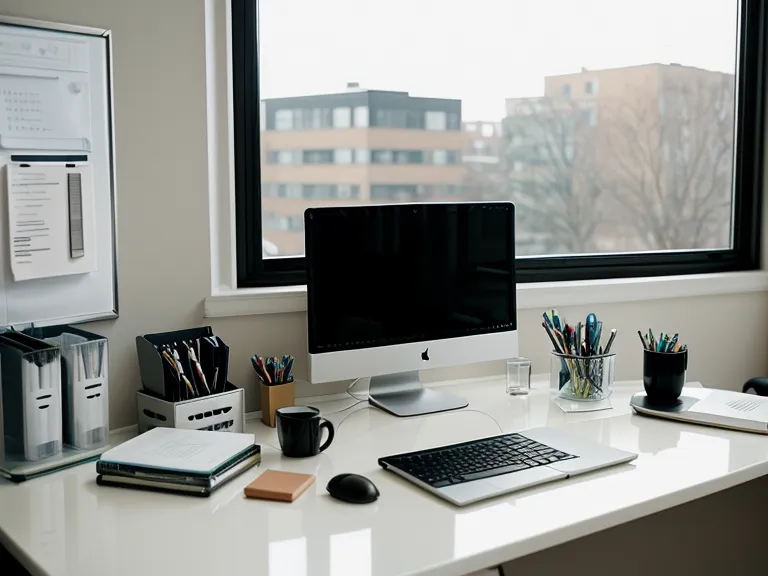
My cursor's been sitting on the same broken div for six minutes, and I've already checked Slack twice without reading either message — which is basically its own remote-work fitness test at this point. That's what focus loss looks like most days when you're a freelance developer working from home: not a dramatic collapse, just a slow leak where the task stays the same size but your grip on it doesn't.
Quick disclosure up front, since a few of the links below are affiliate ones: if you buy through them I earn a small commission at no extra cost to you. I'm not a doctor, not a productivity coach — just a freelancer who tracked what actually helped the brain fog against what turned out to be expensive placebo.
What's Actually Behind This Remote-Work Focus Problem?
Honestly, the biggest misconception is that this is a discipline problem — like I just need to want it more. It isn't. Bouncing between a client's Slack thread, a pull request, and a half-written proposal costs more than the few seconds it takes to alt-tab; it's closer to that context-switching cost engineers talk about when a process gets swapped out and has to reload its whole state before it can do anything useful again. Do that fifteen times before lunch and your ability to recall what you were even building starts to genuinely degrade, not because you're lazy but because no single task ever got enough runway to load. That's also the line I'd draw between brain fog and just being unmotivated — motivation doesn't explain why you can reread the same paragraph of a spec four times and still not retain it. Somewhere in the middle of one rough quarter I started tracking my focus hours like my billable hours, mostly to prove to myself I wasn't imagining the drop-off.
Brain Fog Versus Just Being Tired
Being tired responds to sleep. Brain fog doesn't — you can get a full night's rest and still open your laptop feeling like you're running a cached version of yourself. The way I eventually told the two apart was by giving myself an actual baseline before changing anything, the same way you wouldn't trust a performance fix without a benchmark first. Once I had that baseline, the mid-afternoon crash stopped looking mysterious; it just showed up at roughly the same point every day regardless of how much coffee came before it. I never went deep into the actual ingredient mechanisms behind the supplements I tried — that's a rabbit hole for people with more chemistry background than me — but I did notice that timing mattered more than which capsule or track I picked.
Does a New Morning Routine Actually Fix It?
Sort of, and not in the way most productivity content pushes it. A rigid five-step morning routine assumes your energy is the same every day, which is a bad assumption for basically every remote worker I know. What actually helped was building something closer to a fixed deep work zone — a specific signal that told my brain the work part had started, regardless of what the rest of the morning looked like. My upstairs neighbor Yuki does quiet co-working sessions with me a couple times a week, and it works less because of the company and more because it's an external flow-state trigger neither of us has to manufacture alone. I also spent a stretch just reducing cognitive load by finally organizing my browser tabs into actual groups instead of dozens of open threads I was subconsciously tracking, which did more for my focus than any app I paid for. I ran the full Pomodoro-timer-and-Notion-dashboard combo for a while too, color-coded and everything, and it mostly gave me a more elaborate way to procrastinate. Not everything I tried earned its keep — there was also a meditation app subscription I opened maybe four times before I forgot it existed on my phone.
Audio Tools and Supplements Did More Than I Expected
The category I was most skeptical of turned out to be the one that stuck: audio-based focus tools. I'd tried the lo-fi-beats-to-code-to route before and usually just ended up vibing along instead of writing functions, so my expectations going into The Brain Song were low. What changed things wasn't the audio alone — it was pairing it with a fixed spot in the day, right between the first coffee and the first commit, since when you use it turned out to matter more than which track you pick. I'd also been blaming the wrong villain for a while, pointing at the high-energy visible light (450-495 nm) from my monitors for everything, when a chunk of what I was calling screen fatigue was really just eye strain from never looking more than two feet away from a screen for nine hours straight. I ran the audio approach against my old capsule-only routine during a stretch I wrote up separately in my Portland home office experiment, and it won mostly because it didn't depend on my stomach cooperating that day. If your focus problem is more visual than auditory — screens and notifications rather than noise — The Genius Song is the one other readers tell me they've had luck with instead.
Should You Leave the House to Reset Your Focus?
Sometimes, yes — but not as a permanent fix, more like a reset button for when the leak gets bad enough that no amount of audio or routine tweaking touches it. I'll grab my laptop and go work a few hours from Oblique Coffee Roasters on SE Division, and the change of scenery does something a fixed routine can't, mostly because nothing in that room is tagged in my head as "nap possible" the way parts of my apartment are. It's not a long-term substitute for fixing the actual problem, though. I know remote workers who treat the coffee shop trip like a cure and end up right back where they started the second they're home again.
What I'd Tell a Client Who Asked Me This Tomorrow
The clearest proof any of this worked wasn't a metric I tracked — it was something Liesel said. She's part of the same Portland-area remote-work Slack community I've leaned on for accountability check-ins, and she opened one of our sessions with an offhand line I kept turning over for weeks afterward, something close to "you actually sound like you're all there today." I hadn't noticed the shift myself until someone else did. Yuki still recommends the same three books every time I bring up focus, and I still haven't read any of them, which tells you plenty about how much of this is really about routines versus reading lists. If I had to boil it down for a client asking me tomorrow: stop trying to hustle your way out of a foggy brain with a harder morning routine. Build one boundary instead — audio, location, whatever actually works for you — that reliably tells your brain the work part has started. Not a cure. Just a boundary. For me that boundary is still The Brain Song, and if you want to see whether an audio-based signal does anything for your own deep work blocks without the caffeine jitters, you can check out The Brain Song here.
Look, I'm not a health professional, and none of this is medical advice — my only real training is a decade of debugging other people's code and, apparently, my own brain. If your fog feels chronic or is affecting a lot more than your ability to finish a sprint on time, talk to an actual doctor before you start stacking audio tracks and supplements. But if your living room has just become a low-grade focus swamp, the fix might be smaller than the productivity gurus want you to believe.